




































-
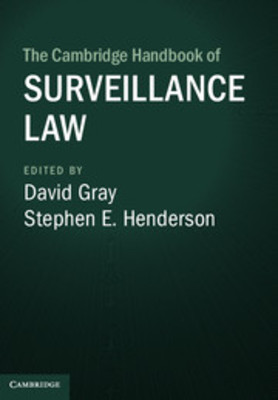
The Cambridge Handbook of Surveillance Law
David C. Gray and Stephen Henderson
Surveillance presents a conundrum: how to ensure safety, stability, and efficiency while respecting privacy and individual liberty. From police officers to corporations to intelligence agencies, surveillance law is tasked with striking this difficult and delicate balance. That challenge is compounded by ever-changing technologies and evolving social norms. Following the revelations of Edward Snowden and a host of private-sector controversies, there is intense interest among policymakers, business leaders, attorneys, academics, students, and the public regarding legal, technological, and policy issues relating to surveillance. This handbook documents and organizes these conversations, bringing together some of the most thoughtful and impactful contributors to contemporary surveillance debates, policies, and practices. Its pages explore surveillance techniques and technologies; their value for law enforcement, national security, and private enterprise; their impacts on citizens and communities; and the many ways societies do - and should - regulate surveillance.
-
The Fourth Amendment in an Age of Surveillance
David C. Gray
The Fourth Amendment is facing a crisis. New and emerging surveillance technologies allow government agents to track us wherever we go, to monitor our activities online and offline, and to gather massive amounts of information relating to our financial transactions, communications, and social contacts. In addition, traditional police methods like stop-and-frisk have grown out of control, subjecting hundreds of thousands of innocent citizens to routine searches and seizures. In this work, David Gray uncovers the original meaning of the Fourth Amendment to reveal how its historical guarantees of collective security against threats of 'unreasonable searches and seizures' can provide concrete solutions to the current crisis. This important work should be read by anyone concerned with the ongoing viability of one of the most important constitutional rights in an age of increasing government surveillance.
-

The Road to Jim Crow
C. Christopher Brown
Making extensive use of primary sources, C. Christopher Brown has broken new ground and filled a long overlooked gap in Maryland history. Here is the story of African Americans on Maryland’s Eastern Shore, from the promise-filled days following the end of slavery to the rise of lynch law, segregation, and systematic efforts at disenfranchisement. Resisting, as best they could, attempts of the Democratic "White Man’s Party" to render them second-class citizens, black communities rallied to their churches and fought determinedly to properly educate their children and gain a measure of political power. The Eastern Shore's Cambridge, guided by savvy and energetic leaders, became a political and cultural center of African American life.
-

Transparent Data Mining for Big and Small Data
Tania Cerquitelli, Daniele Quercia, and Frank A. Pasquale
This book focuses on new and emerging data mining solutions that offer a greater level of transparency than existing solutions. Transparent data mining solutions with desirable properties (e.g. effective, fully automatic, scalable) are covered in the book. Experimental findings of transparent solutions are tailored to different domain experts, and experimental metrics for evaluating algorithmic transparency are presented. The book also discusses societal effects of black box vs. transparent approaches to data mining, as well as real-world use cases for these approaches.As algorithms increasingly support different aspects of modern life, a greater level of transparency is sorely needed, not least because discrimination and biases have to be avoided. With contributions from domain experts, this book provides an overview of an emerging area of data mining that has profound societal consequences, and provides the technical background to for readers to contribute to the field or to put existing approaches to practical use.
-
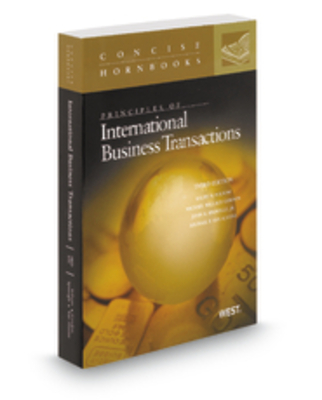
Principles of International Business Transactions, 4th ed.
Ralph H. Folsom, Michael Wallace Gordon, Michael P. Van Alstine, and Michael D. Ramsey
The Fourth Edition of Principles of International Business Transactions provides a more comprehensive examination of the law relevant to the subject matter and detailed citations to caselaw and other supporting authorities. It can be used by courts and legal practitioners as a resource for research and analysis, as well as by students and professors as a supplement for any international business law course. It tracks the authors' popular problem-oriented coursebook, International Business Transactions, and their three spin-offs Contracting Across Borders, Trade and Economic Relations and Foreign Investment Law. Coverage moves sequentially from structuring international sales transactions to international sales law and letters of credit to regulation of international trade to transfers of technology to foreign investment to international business dispute settlement.
-

Legal Negotiation: Theory and Practice, 3d ed.
Donald G. Gifford and Robert J. Rhee
This classic text is specifically designed to teach students how to negotiate in the actual practice of law. Although practical, it is grounded in ongoing research by social science, law, and business school scholars. In this new edition, Professor Robert Rhee joins Professor Gifford, and brings with him both a background in transactional negotiations and expertise in economic analysis of negotiation.
-
Developing Professional Skills: Criminal Procedure
Renée M. Hutchins
Faculty teaching criminal procedure often find it difficult to craft relevant, well-defined exercises that require students to apply the rules governing the investigation and adjudication of criminal cases. This innovative book offers ten separate assignments that encourage students to develop the wide range of skills they will need for the effective practice of law. Each of the exercises is grounded in well-known and widely-taught rules of criminal procedure. Consequently, the book can be used with virtually any criminal procedure text. Students using the book will have the opportunity to develop skills such as:
- Writing an email in a professional setting
- Brainstorming case strategy
- Drafting a suppression motion
- Negotiating a plea
- Drafting an appellate brief
- Making an oral argument
Call number: KF9619.85 .H87
-
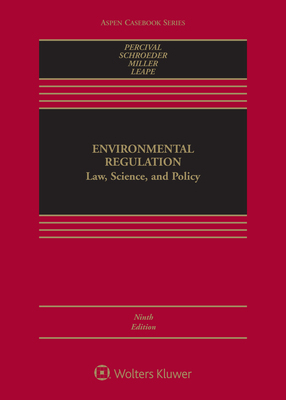
Environmental Law: Statutory and Case Supplement, 2017-2018
Robert Percival and Christopher H. Schroeder
-
Principles of Federal Income Taxation
Donald B. Tobin and Samuel A. Donaldson
The perfect companion for students in law school tax courses and practitioners seeking a helpful introduction, this popular reference has been completely updated to reflect recent developments. Like prior editions, it includes analysis of cases and concepts from the leading casebooks on federal income tax, complete with explanations, diagrams and flow charts. The book includes extensive treatment of the time value of money issues.
-
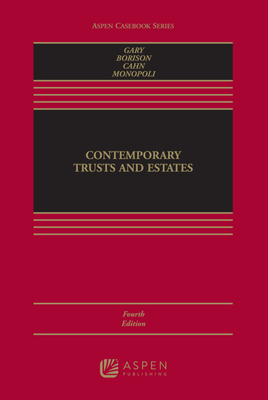
Contemporary Trusts and Estates, 3d ed.
Susan N. Gary, Jerome Borison, Naomi R. Cahn, and Paula A. Monopoli
The third edition of Contemporary Trusts and Estates captures the rapid evolution of doctrine in trusts and estates law that has occurred over the past half-century in response to profound societal and demographic changes. Based on recent developments in legal education, this casebook integrates legal analysis, judgment and perspective, ethics, and practice skills. It focuses simultaneously on the theoretical foundations and practical applications of the material, teaching students by using traditional case analysis and, at the professor’s option, innovative exercises.
-
Administrative Law: A Contemporary Approach, 3d ed.
Andrew F. Popper, Gwendolyn M. McKee, Anthony E. Varona, Philip J. Harter, Mark C. Niles, and Frank A. Pasquale
Since 2010, the Court has been busy clarifying, expanding, modifying, and redefining fundamental components of administrative law. This new edition presents 13 of these cases and 200 other notes bringing students and faculty up-to-date in this dynamic field. Tucked within the core of the traditional curricular structure are King (the Affordable Care Act),Obergefell (same-sex marriage), Free Enterprise Fund (yet another case on presidential removal power), Canning (recess appointments), Mack Truck (good cause exception),Arlington (the capacity of agencies to define their authority), Stern (on non-Article III courts) and much more.
-
International Trade and Economic Relations in a Nutshell, 6th ed.
Ralph H. Folsom, Michael Wallace Gordon, and Michael P. Van Alstine
This Nutshell examines the legal rules governing international trade and economic relations. After initial chapters on the legal and practical environment for trade enterprises, it analyzes the principal institutions and rules governing international trade. Special attention is paid to the World Trade Organization (WTO), the General Agreement on Tariffs and Trade (GATT), the WTO Dispute Settlement Body, regulation of imports (including tariff rates, customs classification and valuation, and rules of origin), and trade remedy responses to import competition. Export controls, foreign corrupt practices, preferential trade agreements, and the trade law of the European Union and the North American Free Trade Agreement are also examined. U.S. law coverage is emphasized.
-
International Business Transactions in a Nutshell, 10th ed.
Ralph H. Folsom, Michael Wallace Gordon, Michael P. Van Alstine, and Michael D. Ramsey
This work examines the law and practices relevant to the principal forms of international business and commercial transactions. It includes chapters on negotiating business transactions; the law governing international sales of goods; structuring international sales transactions; financing such transactions, especially through letters of credit; technology transfers; the initiation, operation, and termination of, as well as the limitations imposed on, foreign investments; property takings, including the options for protecting against and remedies for such actions; the extraterritorial regulation of international business; anti-corruption law; and the resolution of international disputes, whether through litigation in domestic court or through international arbitration.
-

Get a Running Start: Your Comprehensive Guide to the First Year Curriculum
David C. Gray, Donald G. Gifford, Mark A. Graber, William M. Richman, David A. Super, and Michael P. Van Alstine
The first of its kind, this book offers a global overview of the first-year curriculum in a single volume. In short, available lessons, Get a Running Start covers all the major concepts taught in each of the courses most commonly offered in the first year of law school: criminal law, torts, civil procedure, constitutional law, property, and contracts. Each of the courses comprising this book is written by a specialist in the field who is a decorated teacher with years of experience in the classroom. In this volume, they have distilled that experience and expertise to produce the tool they wish they had when they first were thinking about and then actually began law school: a clear, concise introduction to the entire first-year curriculum. Get a Running Start is a valuable tool for first-year law students, giving them a running start on their law school careers and putting them in the best position to enter the profession. By reading through all the lessons for a course, first-year students will get a complete overview of each course early in the semester. As the semester goes forward, students can accelerate their learning and comprehension by reviewing individual lessons when preparing for class. As the semester comes to a close, the lessons in this book provide an invaluable framework for outlining and exam preparation. Get a Running Start is also the ideal introduction for undergraduate students. For formal pre-law or Introduction to American Law courses, this book will provide students with a comprehensive overview broken into concise, digestible chunks that are ideal for further development in lecture or discussion sections. Outside the classroom, Get a Running Start offers a stimulating introduction to fundamental legal concepts that will engage those who might be thinking about going to law school and citizens who simply want to know more about the law as a central feature of public life. Among the many features of this book readers will find useful and attractive are: •An introductory chapter offering advice on how to structure a successful preparation and study process starting with the summer before law school and running straight through exams.•Insiders' advice from successful law students and recent graduates on class preparation, course selection, career development, and managing the stress of law school.•Short lessons that provide readers with an introduction to the major concepts for a day or week of law school classes in 10-15 minutes.•Complete course coverage that will allow readers to get a global overview of a first-year law course in the span of an afternoon.•Frequent use of examples and hypotheticals to illustrate major points in an available way.•Short "Takeaway" summaries at the end of each lesson that highlight the main points and provide a quick reference or refresher.•"Bonus" lessons offering quick primers on topics such as legal reasoning and statutory interpretation.
-
Against All Odds: How America's Century-Old Quest for Clean Air May Spur a New Era of Global Environmental Cooperation
Robert Percival
Healthy air quality is a growing global concern. Robert Percival discusses the critical junctures in U.S. environmental history that have led to global environmental regulation, particularly in relation to China. According to the World Health Organization in 2013, more than one million people die every year in China from exposure to air pollution. Referencing historical U.S. air quality achievements, particularly the Clean Air Act, Percival points toward a turning point in China's legislation and attitude towards this environmental issue.
-
The Oxford Handbook of the U.S. Constitution
Mark Tushnet, Mark A. Graber, and Sanford Levinson
Offers a comprehensive overview and introduction to the U.S. Constitution from historical, political, legal, rights, and thematic perspectives. Focuses on the Constitution's development, structure, and role in the U.S. political system and culture. Enables a critical comprehension of the literature on the Constitution's history, major issues in U.S. constitutional politics, the Constitution's legal framework, and the current themes in constitutional scholarship. Includes all major contemporary constitutional topics and controversies with perspectives from different disciplines. Offers accessible and up-to-date analysis.
-
Comparative Perspectives on Gender Violence: Lessons from Efforts Worldwide
Rashmi Goel and Leigh S. Goodmark
The United States has uncritically exported its law and policy on gender violence without regard to effectiveness or cultural context, and without asking what we might learn from efforts to combat gender violence in the rest of the world. This book asks that question. Comparative Perspectives on Gender Violence: Lessons From Efforts Worldwide documents the global scope of gender violence, from countries where the legal response is just emerging to countries with longstanding law and policy regimes. Informed by international human rights law, Comparative Perspectives on Gender Violence examines policy successes and failures and grassroots efforts to elicit a robust and proactive response from China to Chile. From the work of local activists to stem the tide of sexual and intimate partner violence after the Haitian earthquake of 2005, to the efforts to eradicate dowry-related violence in India, to the public education campaigns to prevent domestic violence in Scotland, Comparative Perspectives on Gender Violence offers a comprehensive vision of efforts around the world to eradicate gender based violence. Featuring the work of leading gender violence academics and activists around the world, Comparative Perspectives on Gender Violence provides a new lens through which to consider U.S. efforts to address gender violence.
call number: HV6626 .C655 2015
-
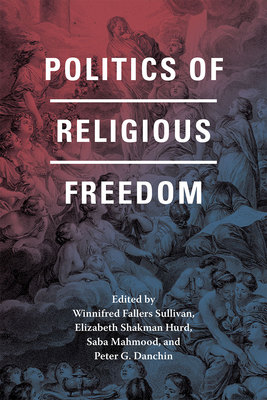
Politics of Religious Freedom
Winnifred Fallers Sullivan, Elizabeth Shakman Hurd, Saba Mahmood, and Peter G. Danchin
In a remarkably short period of time, the realization of religious freedom has achieved broad consensus as an indispensable condition for peace. Faced with widespread reports of religious persecution, public and private actors around the world have responded with laws and policies designed to promote freedom of religion. But what precisely is being promoted? What are the cultural and epistemological assumptions underlying this response, and what forms of politics are enabled in the process?
The fruits of the three-year Politics of Religious Freedom research project, the contributions to this volume unsettle the assumption—ubiquitous in policy circles—that religious freedom is a singular achievement, an easily understood state of affairs, and that the problem lies in its incomplete accomplishment. Taking a global perspective, the more than two dozen contributors delineate the different conceptions of religious freedom predominant in the world today, as well as their histories and social and political contexts. Together, the contributions make clear that the reasons for persecution are more varied and complex than is widely acknowledged, and that the indiscriminate promotion of a single legal and cultural tool meant to address conflict across a wide variety of cultures can have the perverse effect of exacerbating the problems that plague the communities cited as falling short. -
Divorced from Reality: Rethinking Family Dispute Resolution
Jane C. Murphy and Jana B. Singer
Over the past thirty years, there has been a dramatic shift in the way the legal system approaches and resolves family disputes. Traditionally, family law dispute resolution was based on an “adversary” system: two parties and their advocates stood before a judge who determined which party was at fault in a divorce and who would be awarded the rights in a custody dispute. Now, many family courts are opting for a “problem-solving” model in which courts attempt to resolve both legal and non-legal issues.
At the same time, American families have changed dramatically. Divorce rates have leveled off and begun to drop, while the number of children born and raised outside of marriage has increased sharply. Fathers are more likely to seek an active role in their children’s lives. While this enhanced paternal involvement benefits children, it also increases the likelihood of disputes between parents. As a result, the families who seek legal dispute resolution have become more diverse and their legal situations more complex.
In Divorced from Reality, Jane C. Murphy and Jana B. Singer argue that the current "problem solving" model fails to address the realities of today's families. The authors suggest that while today’s dispute resolution regime may represent an improvement over its more adversary predecessor, it is built largely around the model of a divorcing nuclear family with lawyers representing all parties—a model that fits poorly with the realities of today's disputing families. To serve the families it is meant to help, the legal system must adapt and reshape itself.
call number: KF505.5 .M868 2015
(also available in ebook format)
-
The New 1L: First-Year Lawyering with Clients
Eduardo R.C. Capulong, Michael A. Millemann, Sara Rankin, and Nantiya Ruan
In The New 1L, leading teachers in the field describe how, in the first year of legal education, they teach students to act, as well as think, like lawyers. In their courses, clients are central not extraneous. Working under a lawyer’s supervision, students interview clients, conduct factual investigations, draft pleadings, and write memoranda and briefs. The authors argue that, in isolation, theory and practice are incomplete, and first-year educators must integrate the two. They discuss the benefits and challenges of this new 1L approach, and also provide a range of successful models for any teacher who wants to adopt this pedagogy to a first-year course. What they say is particularly relevant today, when many are criticizing law schools for their over-reliance on the Langdellian teaching method and failure to produce practice-ready graduates.
The innovative courses the authors describe bring about collaborations between classroom instruction, legal research and writing (LRW), and interactions with clinical teachers and lawyers (appointed, or not, as adjunct faculty). These collaborative teaching models are essential to the future success of legal education, the authors contend. These models include LRW courses that base assignments on actual legal work, core courses that add practice components to traditional theoretical instruction, courses adding skills instruction and actual client work to the 1L curriculum, and courses that invite 1L students to enroll in clinics.
This book is a must-read for deans, curriculum committees, and legal educators.
call number: KF282 .N49 2015
-

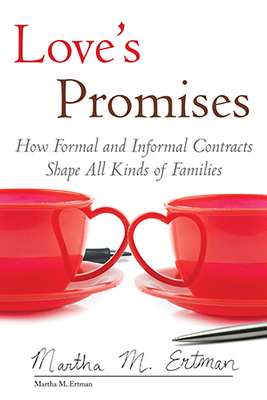
Love's Promises: How Formal and Informal Contracts Shape All Kinds of Families
Martha M. Ertman
Most people think of love and contracts as strange bedfellows, or even opposites. In Love’s Promises, however, law professor Martha Ertman shows that far from cold and calculating, contracts shape and sustain families.
Blending memoir and law, Ertman delves into the legal cases, anecdotes, and history of family law to show that love comes in different packages, each shaped by different contracts and mini-contracts she calls “deals.” Family law should and often does recognize that variety because legal rules, like relationships, aren’t one size fits all. The most common form of family—which Ertman calls “Plan A”—come into being through different kinds of agreements than the more uncommon families that she dubs “Plan B.” Recognizing the contractual core of all families shows that Plan B is neither unnatural nor unworthy of legal recognition, just different.
After telling her own moving and often irreverent story about becoming part of a Plan B family of two moms and a dad raising a child, Ertman shows that all kinds of people—straight and gay, married and single, related by adoption or by genetics—use contracts to shape their relationships. As couples navigate marriage, reproductive technologies, adoption, and cohabitation, they encounter contracts. Sometimes hidden and other times openly acknowledged, these contracts ensure that the people they think of as “family” are legally recognized as family in the eyes of the law.
Family exchanges can be substantial, like vows of fidelity, or small, like “I cook and you clean.” But regardless of scope, the agreements shape the emotional, social, and financial terrain of family relationships. Seeing the instrumental role contracts will help readers better understand how contracts and deals work in their own families as well as those around them.
Both insightful and paradigm-shifting, Love’s Promises lets readers in on the power of contracts and deals to support love in its many forms and to honor the different ways that our nearest and dearest contribute to our daily lives.call number: K699 .E78 2015
-
The Black Box Society: The Secret Algorithms that Control Money and Information
Frank A. Pasquale
Every day, corporations are connecting the dots about our personal behavior—silently scrutinizing clues left behind by our work habits and Internet use. The data compiled and portraits created are incredibly detailed, to the point of being invasive. But who connects the dots about what firms are doing with this information? The Black Box Society argues that we all need to be able to do so—and to set limits on how big data affects our lives.
Hidden algorithms can make (or ruin) reputations, decide the destiny of entrepreneurs, or even devastate an entire economy. Shrouded in secrecy and complexity, decisions at major Silicon Valley and Wall Street firms were long assumed to be neutral and technical. But leaks, whistleblowers, and legal disputes have shed new light on automated judgment. Self-serving and reckless behavior is surprisingly common, and easy to hide in code protected by legal and real secrecy. Even after billions of dollars of fines have been levied, underfunded regulators may have only scratched the surface of this troubling behavior.
Frank Pasquale exposes how powerful interests abuse secrecy for profit and explains ways to rein them in. Demanding transparency is only the first step. An intelligible society would assure that key decisions of its most important firms are fair, nondiscriminatory, and open to criticism. Silicon Valley and Wall Street need to accept as much accountability as they impose on others.
call number: HN49.P6 P375 2015
-
Learning Criminal Procedure
Ric Simmons and Renée M. Hutchins
Learning Criminal Procedure teaches students the law of criminal procedure by presenting clear, succinct sets of rules for each topic, summaries of actual cases that illustrate how the rules operate in practice, and substantial excerpts from leading Supreme Court cases. Evolving areas of law are highlighted for the students, and the book contains over one hundred review questions that can be used for classroom discussion or for reinforcing what the students learn in each chapter. The book's authors build on their combined decades of practical experience to explore the law in straightforward text that enables students to easily engage with the subject.
call number: KF9619 .S55 2015
-
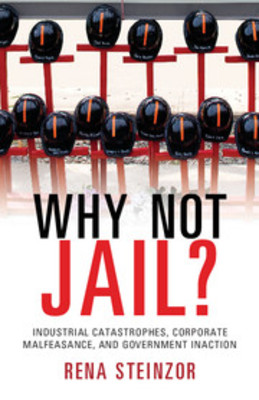
Why Not Jail? Industrial Catastrophes, Corporate Malfeasance, and Government Inaction
Rena I. Steinzor
The U.S. Department of Justice is under fire for failing to prosecute banks that caused the 2008 economic meltdown because they are too big to jail. Prosecutors have long neglected to hold corporate executives accountable for chronic mistakes that kill and injure workers and customers. This book, the first of its kind, analyzes five industrial catastrophes that have killed or sickened consumers and workers or caused irrevocable harm to the environment. From the Texas City refinery explosion to the Upper Big Branch mine collapse to the destruction of the Deepwater Horizon oil rig and extending to incidents of food and drug contamination that have killed or injured hundreds, the root causes of these preventable disasters include crimes of commission and omission. Although federal prosecutors have made a start on holding low-level managers liable, far more aggressive prosecution is appropriate as a matter of law, policy, and justice. Written in accessible and jargon-free language, this book recommends innovative interpretations of existing laws to elevate the prosecution of white-collar crime at the federal and state levels.
call number: KF9350 .S74 2014
-
Hate Crimes in Cyberspace
Danielle Keats Citron
Most Internet users are familiar with trolling—aggressive, foul-mouthed posts designed to elicit angry responses in a site’s comments. Less familiar but far more serious is the way some use networked technologies to target real people, subjecting them, by name and address, to vicious, often terrifying, online abuse. In an in-depth investigation of a problem that is too often trivialized by lawmakers and the media, Danielle Keats Citron exposes the startling extent of personal cyber-attacks and proposes practical, lawful ways to prevent and punish online harassment. A refutation of those who claim that these attacks are legal, or at least impossible to stop, Hate Crimes in Cyberspace reveals the serious emotional, professional, and financial harms incurred by victims.
Persistent online attacks disproportionately target women and frequently include detailed fantasies of rape as well as reputation-ruining lies and sexually explicit photographs. And if dealing with a single attacker’s “revenge porn” were not enough, harassing posts that make their way onto social media sites often feed on one another, turning lone instigators into cyber-mobs.
Hate Crimes in Cyberspace rejects the view of the Internet as an anarchic Wild West, where those who venture online must be thick-skinned enough to endure all manner of verbal assault in the name of free speech protection, no matter how distasteful or abusive. Cyber-harassment is a matter of civil rights law, Citron contends, and legal precedents as well as social norms of decency and civility must be leveraged to stop it.
call number: HV6773.15.C92 C57 2014
Printing is not supported at the primary Gallery Thumbnail page. Please first navigate to a specific Image before printing.